Customer success story
VariQuest and the holy grail of cloud connectivity
Varitronics kept Salesforce as its CRM, moved its ERP to Microsoft Dynamics 365 Business Central, and connected the two with Rapidi. Nine months of preparation, live on schedule, and no gotchas on day one.
Varitronics LLC, a Minnesota wholesaler of specialised printers to schools, had run Salesforce since the early 2000s. In 2018 it replaced Ascent, a Salesforce-based ERP it was never fully satisfied with, and moved to Microsoft Dynamics 365 Business Central. Rapidi synchronises accounts and products between the two, with credit limits and credit holds flowing back the other way. The system went live as scheduled on 2 January 2019.
Talk to an integration expert
About Varitronics
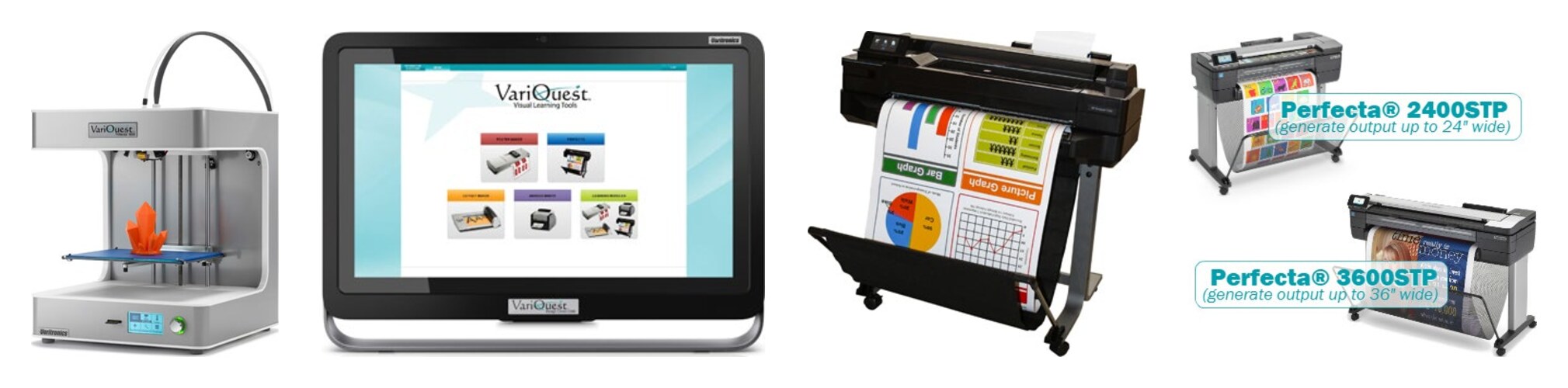
Varitronics, LLC is a Minnesota-based company that does business as “VariQuest Visual Learning Tools”. It is a major US wholesaler of specialised printers to schools — wide-body, 3-D and label printers, along with related equipment like laminators and die cutters. It distributes through a network of strategically located dealers as well as directly to customers.
Varitronics’ customer base includes more than 30,000 early childhood centres, elementary schools, secondary schools and post-secondary institutions throughout North America. The VariQuest product suite lets students and teachers quickly create visual supports that help differentiate instruction, create school uniformity and engage students. The company is privately held and headquartered in Brooklyn Park, Minnesota. More at variquest.com.
Ascending to the cloud
Varitronics has used Salesforce since the early 2000s, when the company was still part of the Brady Corporation. After becoming independent in 2012 the team saw no reason to change their CRM: Salesforce met many of the needs of their sales and management teams. Their ERP was a different story.
They could no longer use the ERP that sat on-premises at their former owner, so they tried to meet their financial, inventory and distribution requirements with Ascent, a Salesforce-based ERP. They were never completely satisfied with it. Once they discovered that NAV was available in a cloud version, they decided it was time for a change.
Being in the cloud was important for our ERP as well as our CRM. Salesforce is the top of the line CRM, and Microsoft now provides the top of the line cloud-based ERP with Dynamics 365 Business Central.
Rapidi, the missing link
Varitronics ran into the same issue as many other companies running both a CRM and an ERP: the two systems do not talk to each other. That forces manual data entry in two places, and a great deal of importing and exporting, which wastes time and creates opportunities for error.
Rapidi was recommended by Stoneridge Software, our implementation partner. Rapidi made a good first impression on us, and we felt comfortable with what they were offering us. We did look at another solution, but it was an easy decision to go with Rapidi and their Rapidi data integration solution.
Varitronics’ Salesforce implementation had been heavily customised, partly because of their previous ERP. Hallbeck did not think that was a good thing: “We actually wanted a fairly vanilla ERP implementation, and that’s what we ended up with. Well, with the exception of the printer serial numbers that are generated in the ERP, and that require some customisation in Salesforce as well.”

In their implementation, accounts are added and updated in Salesforce and synchronised by Rapidi into Dynamics 365 Business Central, with only credit limits and credit holds going in the other direction. All the details about products are entered in Business Central, and Rapidi transfers new and updated product information over to Salesforce.
“In the end,” Hallbeck reports, “I don’t think our implementation was far out of the norm. Using Salesforce only for its intended purpose as a CRM means that we don’t have nearly as much customisation as before. Which is a good thing.”
Take it with you
The whole story as a PDF
Seven pages: the move off a Salesforce-based ERP, what synchronises which way, the January go-live with no gotchas, and Tom Hallbeck on his seventh ERP implementation. Yours after one short form.
Smooth sailing
Hallbeck has twenty years of experience with ERP implementations, and he does not underestimate them.
They are not for the faint of heart, and can be really challenging. Even 3, 6 or 9 months after the system is turned up it still might not be where it should be. I think this was my seventh ERP implementation, and from top to bottom it was the best. Rapidi was a big part of this.
He is as complimentary about the consultants as about the product: “The Rapidi consultant was always there for us, and often worked early or late to accommodate our needs in a different time zone. My team member who worked closely with the consultant was also extremely appreciative.”
“The best part,” he remembers, “was that when we went live on January 2nd we didn’t find any ‘gotchas’, we just needed a few tweaks. It’s been three months now and the system hasn’t been down even once. The connections are working exactly like Rapidi promised us they would.”
Afterthoughts
With the implementation complete, the gains showed up first in reporting. “Our management team benefits the most,” Hallbeck says. “Before, we had a hard time with our previous ERP system trying to get really good sales-person and customer sales reporting. We knew that Salesforce would hold some information, and our Business Central would have other. But because they are connected so smoothly we can produce reports without having to worry where the data originates.”
User adoption was not a problem either. “Change is always difficult, even when it’s for a good reason,” he notes, “so we had many meetings in advance with our user group to prepare them as best we could. We are continuing to meet with them, and the atmosphere is positive. I think it’s going to get better and better in the future, as our users take advantage of more and more of the information that is now available to them.”

The best thing about Rapidi is that it is very simple — it just works. And when we need help or advice, the Rapidi consultants are always there for us. They not only know their own product, they are experts on both Salesforce and Business Central as well.
Even the dealer network benefited. Hallbeck has had positive feedback from them: “They are finding that it is much easier to enter orders, and that’s obviously really good for us.”
Advice for others

Many Rapidi customers start with an ERP and implement Salesforce later. Varitronics went the other way, putting in a new ERP alongside an existing Salesforce implementation, so Hallbeck has advice for anyone on the same path.
“Give yourself enough time! ERP implementations can be very difficult. We gave ourselves 9 months, just to be sure that we had a good system on Day 1. And we did.”
He does not hesitate to recommend Rapidi: “Anyone who asks me, who has similar needs, I will tell them to check out Rapidi.”
Replacing an ERP alongside an existing CRM?
Tell us which ERP you are moving to and which Salesforce edition you run, and we will tell you whether a standard Rapidi template covers you.